

Employer Newsletter – Spring 2025
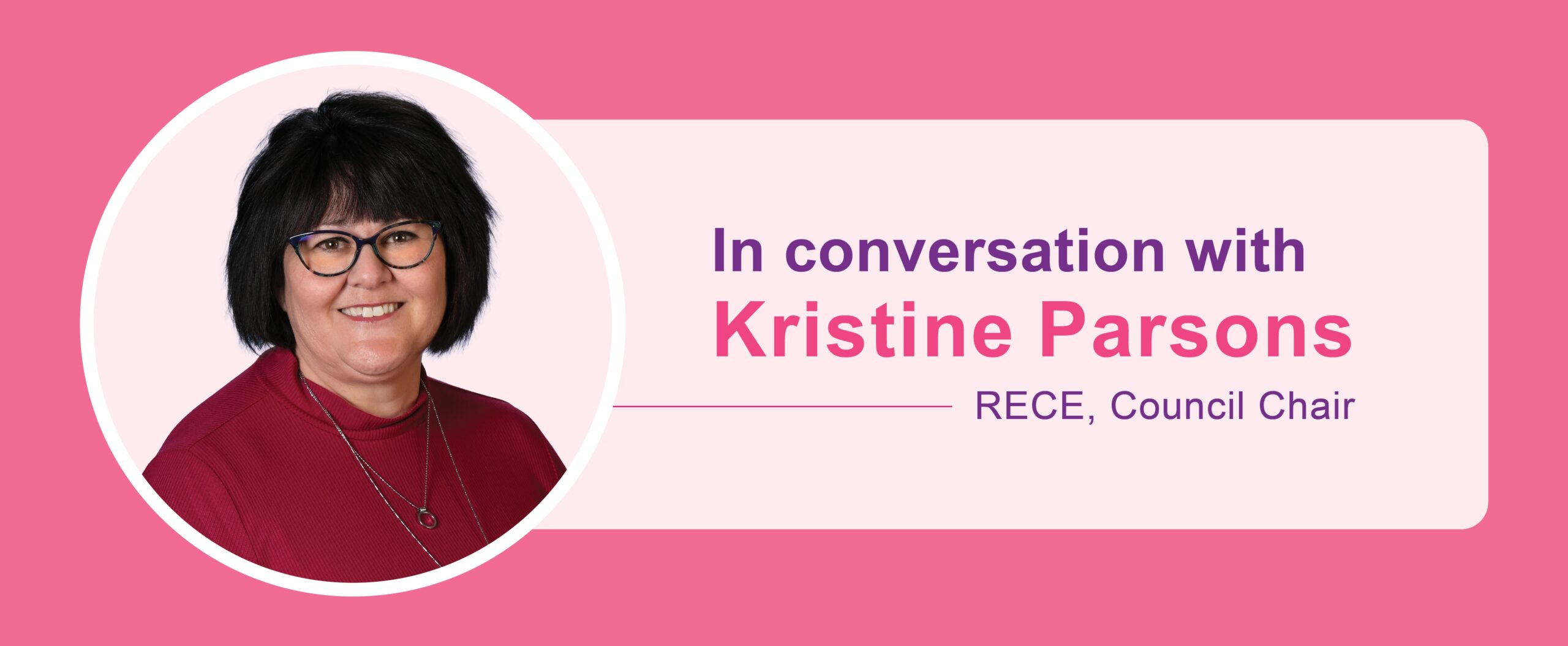
A resilient, flourishing profession: Council Chair Kristine Parsons on supporting well-being in the workplace
The topic of mental health comes into focus every May in Canada during Mental Health Awareness Month, shining a light on the need for understanding, breaking down of stigmas and resilience-building. We know, however, that the work of understanding and supporting overall well-being for self and others is an ongoing practice and commitment. This is certainly the case for Council Chair Kristine Parsons RECE, Director of Operations at RisingOaks Early Learning Ontario in Kitchener, one of the largest early learning and care providers for families in the Waterloo region.
Built into the College’s strategic plan, and part of the legacy she herself wants to leave, is a healthy, resilient, flourishing profession. For Kristine, mental health is but one piece of the well-being picture. Setting a foundation for the well-being and resiliency of her own staff of 180 educators is about creating a trusting, caring environment for mind, body and soul.
Leading with curiosity
“Our well-being is our mind, our body and our soul, and sometimes they are out of alignment,” says Kristine. Keeping in mind the interconnectedness of how we think, act and feel helps encourage compassion and grace toward others. A backache might not just be from sitting all day, but rather from the stress that someone is feeling, she says. “If we can ask, What’s happened or What is happening to you, instead of What’s wrong with you, we can be a lot more gracious. The more gracious I am, the less judgmental I am, the more curious I am,” says Kristine. “Personally, as I embrace this idea of being gracious, it is actually impacting my own well-being.”
Psychological safety
Before educators can feel comfortable sharing what’s happening to them, they need to feel psychologically safe. Kristine and her team have done a lot of work with RisingOaks’ leaders to guide them in building a culture of open, honest communication and making space for tough conversations. “Trust can be a tricky thing. We build it one marble at a time in the jar,” she says. “Sometimes we find that where it starts is in relationships: the more someone feels seen, heard, acknowledged and understood, the more they feel they belong.”
Meetings are the setting for not just tough conversations, but all conversations. “We’ve worked hard as an organization to use staff meetings for adult conversations: collaboration, networking, consensus-building, problem solving. And not always something to learn. Or not always something to be ‘talked at’ about.”
When it comes to relationship-building, she also offers that leaders can leverage the same tools and skills that RECEs have in building relationships with children, in their own relationships with educator staff.
Self-care
As an employer, RisingOaks recognizes the importance of well-being, and has worked hard – and continues to do so — to provide benefits to its staff. Kristine encourages staff to take advantage of the benefits for things like visits to the dentist, massage therapist or physiotherapist. They’ve also changed their sick days to well-being days, to allow staff to plan for wellness-based time off.
To nurture her own well-being so that she is equipped to support her staff, Kristine models self-care through intention and scheduling. One self-care activity she does is to keep a blanket and pillow in her car, so she can create a private space for reading during a work break.
If carving out time for self-care in the day-to-day feels like a hurdle, she suggests scheduling time for activities like walks or connecting with others, or indulging in your favourite coffee or coffee-shop snack. “Find the things that that you like and then make sure you schedule those. They don’t have to cost money,” she says.
———–
Read more from Kristine:

Fostering equitable care for Black children and families
Tonja Armstrong-MacInnis, Deirdra Joseph, and Nicole Cummings-Morgan, co-leads of the Community of Black ECEs, a Care Collective of the Association of Early Childhood Educators of Ontario (AECEO), share their voices as part of our ongoing conversation series exploring Black history and excellence.
With an emphasis on how we may address anti-Black racism in our systems and structures, Tonja, Deirdra, and Nicole promote continuous learning, reflection, and action in this second piece in the series, to help create inclusive, equitable environments that assist Black families and children.
Excerpts of this conversation are included below, with more to come in a future issue of this newsletter. We encourage you to share this article with RECE staff and colleagues.
What does it mean and look like, to provide equitable care for Black children and families? How can RECEs help foster inclusive environments for all children?
Tonja: To provide equitable care for Black children and families means many things – educators need to be welcoming, open and inviting. They need to provide opportunities for families to come into the programs and share stories, cooking, pictures and traditions that bring value and acceptance to and for Black families. Black children need to be seen as having potential – to become whatever it is that they want to, to have joy in the experiences around them, to not be judged as being harsh, tough, and even sometimes violent (we have a high number of Black children who are seen as the aggressor – just because they are Black). So again, this goes back to educators and staff in the early learning and care field checking their biases and understanding that their views and perceptions may hurt or hinder the very children that they are to be caring for.
Deirdra: Black people are not a monolith. RECEs can support children and their families by building relationships and learning about their specific cultures, traditions and daily routines to make them feel more comfortable, welcomed and understood. Centres can incorporate what they have learned into their programs throughout the year and not just during Black History Month.
Nicole: Providing equitable care for Black children and families looks like a child loving their day – EVERYDAY! And while this may not be possible – children are going to complain about something – the idea is that their only complaints are about spilling their favourite drink during snack time. RECEs can help foster inclusive environments for all children by reflecting on their practice, strengthening their self-awareness skills and honestly, going back to our foundational documents. In the workshops that I present to RECEs, one of the interactive pieces is to look for the words from the Seven Grandfather Teachings (a set of Anishinaabe guiding principles) – humility, bravery, honesty, wisdom, truth, respect and love, and then find them in the Code of Ethics Standard of Practice, How Does Learning Happen?, ELECT , and the Kindergarten Program . If we get back to the basics of what we learned in our ECE programs, we would not be having what seems to be an ongoing conversation on how to HELP RECEs foster inclusive environments; instead we would be seeing it!
How does recognizing and learning about the achievements of Black communities (both historical and ongoing) benefit all in the early learning environment?
Tonja: We all need to know that within our lives we have choices and we can learn and grow from the past. We can have a career or passion for something new – that is exciting and needs to be fostered. As humans, we need to see that others have paved the way for us, and be thankful, and then decide, as children or even adults, to walk the same route or use that same route to build a highway for others. History strengthens us and can build a sense of pride in a community that is often perceived of and viewed as negative. Achievements of Black people are plentiful and benefit us. For example, Garrett Augustus Morgan, Sr., a Black American inventor who created the traffic light. When we celebrate history and achievements, children can see themselves in the world around them and when that is positive, engaging and exciting – it makes them curious and engage in lifelong learning.
Deirdra: Historically, Black achievements have not been recognized, acknowledged or have been credited to non Blacks. The history of Black people cannot be covered in one month, which is why it should be included in everyday curriculum. Black history did not start at slavery, but it is far too often presented that way. We have made significant contributions to the world and continue to do so, but it is not always at the forefront because of the Eurocentric lens that society is based on. I was born and raised in Canada and did not learn about the richness and achievements of Black people in Canada until my post-secondary education. When children see people who look like them, speak like them, eat the same foods and wear the same clothing as them, their sense of self-worth can be established, fostered and sets Black children up to be proud of who they are.
Nicole: When we recognize and learn about the achievements of Black communities, we can better understand what their contributions meant to our society. When this information is made clear in the early learning environment, we are promoting the strengths and abilities of prominent figures who our children can look up to. I should add – who we can all look up to!
Not having access to the achievements of my Black community while growing up was a disservice. By not learning about it early, I believe it created a glass ceiling for me. I couldn’t see what I was capable of. Seeing Black entertainers, actors and athletes didn’t appeal to me because, one, I didn’t have any of those skills; and two, they were not part of my purpose. However, if I had seen more educators and business owners, I would have started my journey to where I am now, much earlier.
My family immigrated to Canada from Jamaica. Their idea of discrimination was in the form of social class and colourism. As newcomers, they were more concerned with making things better for our family and therefore, did not see the need to focus on the historical or ongoing achievements of individuals within our Black community, which, for me, meant not a lot of discussions at home on Canadian Black history. At school, it definitely wasn’t being discussed. I mean, even Indigenous history was merely about ”Native Indians” and how they got things for free. The stereotypes were ludicrous.
Now that I have the chance to learn about the achievements within my Black communities through my own research, I’m excited to share it with the children, youth and young adults I work with. By doing this, I’m breaking cycles and creating a more inclusive early learning environment for ALL the children and families whom I believe will appreciate it.
Resources for RECEs Curated by Tonja, Deirdra and Nicole
For employers and RECEs who are looking to deepen their understanding of Black history and anti-Black racism, there are support resources available. The Community of Black ECEs have also curated a list of children’s books RECEs can read to children in their care, fostering meaningful conversations about diversity, inclusion and belonging.
Stay tuned for the next instalment of this dialogue in a future issue.
Read more in this series:
Celebrating Black History Through Reflection and Action
—————————-
BIOGRAPHIES
Tonja Armstrong-MacInnis, a 2021 Prime Minister’s Award Recipient for Teaching Excellence in Early Childhood Education, has over 30 years of experience in varying capacities within the field of early learning and care – including facilitating numerous workshops that incorporate early learning pedagogy with an anti-oppression and anti-racist lens. In addition to her diploma in Early Childhood Education, she holds a BA and MA in Early Childhood Studies. She is the Director of the Humber Child Development Centre and Manager of the City of Toronto’s Every Child Belongs Unit at Humber that consists of Resource Consultants and a Registered Nurse Practitioner.
Deirdra Joseph began her Early Childhood Educator journey at Seneca College. During her time as an RECE, she would often connect with the children who had needs, particularly those with Autism. This led her to obtain her Resource Teacher certificate and completing the Autism and Behavioral Science program at Seneca College. She also holds a bachelor’s degree in music. She currently works for the City of Toronto as a Resource Consultant.
Nicole Cummings-Morgan is a mentor, advocate, community connector and collaborator. In addition to her RECE designation, she’s also an Ontario Certified Teacher, a professor in Early Childhood Education, an author and the owner and Executive Director of W1derus Educational Workshops Inc. W1derus Educational Workshops Inc. is a social enterprise dedicated to providing personal and professional workshops that contribute to the holistic well-being of individuals throughout their lifespan. Nicole is a former member of the Board of Directors of the Association of Early Childhood Educators of Ontario and the founder of the Community of Black ECEs.

2025 College Council Election Results
The College is pleased to welcome new and returning members to Council representing the Toronto Region (District 5) and Hamilton / Niagara Region (District 7). Council members will serve for a three-year term starting June 2025.
The 24-person Council governing the College oversees policy development and makes decisions related to entry-to-practice requirements, ethical and professional standards, professional misconduct, incompetence and incapacity.
As an employer, if you’d like to learn more about the election process and the role of Council, you can read our article from the Fall 2024 issue of the Employer Newsletter.
Please join us in congratulating our new and returning Council members:
Katherine Begley – District 5
Katherine (Katie) is a professor at the University of Guelph. For the past three years, Katie has served on the Council and on various committees within the College throughout her term. “This experience, combined with my 14 years of post-secondary teaching experience in ECE, provides me with current knowledge of the ECE field as well as insight into challenges that new professionals entering the field may be experiencing, which can have a direct impact on the children and families within our province.”
Laurel Higgins – District 5
Laurel (Laurie) is a professor in Early Childhood Education at Seneca Polytechnic. She brings extensive experience in the areas of curriculum, ethics, family resources and music. “My unique insights and lived experiences will contribute and complement those of the existing Council members, helping shape the future of early childhood education. The bonus will be that I am able to connect with like-minded professionals and gain new leadership skills along the way.”
Rick Nankissoor – District 5
Rick is a manager at Centennial College with the Child Care Lab School. Having worked in lab schools,community-based child care, unionized settings on both sides, teaching future RECEs and mentoring for the College of Early Childhood Educators, Rick has a well-rounded view on the many layers and intricacies of the ECE field. “I’ve been a part of many facets in the child care and early learning field since my first position as an ECA in 1991. I’ve been in this sector for over three decades and have seen the amazing evolution and changes. Living in Toronto all my life and working in a variety of settings and demographics influenced my passion for this field.”
Samia Javed – District 7
Samia is a doctoral student researching how leadership, growth and capacity-building of Registered Early Childhood Educators (RECEs) within Ontario public school boards impact our youngest learners. Samia is an RECE who works for the Hamilton Wentworth District School Board in Early Intervention. “I bring over 15 years of experience as a dedicated educator and advocate, fostering inclusive relationships with children and families, teaching and mentoring post-secondary early years students, and building meaningful connections within diverse communities.”
Save the Date: Ontario Mentorship Collaborative Symposium (Oct. 2 – 3)
To support awareness around the importance of mentorship in the profession, the College is sharing information with the early years sector about the newly formed Ontario Mentorship Collaborative (OMC) and their upcoming symposium.
The Collaborative supports the idea that mentorship is essential in supporting our early years professionals at every stage of their careers, fostering growth, enhancing quality, facilitating the successful induction of new educators and improving staff retention.
The symposium will be held on October 2 and 3, 2025 at the Pearson Convention Centre in Brampton, Ontario. This symposium will also be available on a virtual platform.
If you would like additional information and/or to be added to the distribution list for updates, please contact the Ontario Mentorship Collaborative at omc@connectwithus.ca or me at bbrown@connectwithus.ca.