

Employer Newsletter – Summer 2025
- NEW: Complaints and Reports portal now online
- New resource for RECEs: Practice Note: Preventing Professional Dishonesty
- Council Chair Kristine Parsons on fostering workplace environments where all belong
- A conversation with Two-Spirit leader and social justice advocate Teddy Syrette: Fostering inclusion through education and allyship
- Preserving a Way of Life
- Perspectives on mental well-being through the lens of Black RECEs

New: Online Complaints and Reports Portal
Available now, the College is pleased to announce the launch of a new Complaints and Reports Portal. The new portal allows employers, the public and members to file complaints or Mandatory Employer Reports in a streamlined, accessible, and user-friendly way. The College’s implementation of the new portal aims to simplify the process for filing reports, which are essential to our mandate to serve and protect the public.
What are the benefits of this new portal?
For employers submitting MERs, use of the new portal will:
- streamline the filing process your process filing, centralizing all of your documents in one place;
- reduce the time you need to submit your report;
- contribute to the submission of complete, accurate and timely reports;
- maintain a high standard of security and confidentiality for all information submitted; and
- allow cases to be processed and resolved more efficiently
How does the portal work?
Please ensure you have all necessary information ready before you begin. For your security and privacy, portal sessions will time out after 45 minutes of inactivity. At that time, your session will end automatically, and unsaved information will be lost.
To avoid disruption:
- Prepare any documents or details you will need to complete your report in advance. i.e. Serious Occurrence Reports, contact information for member(s)and/or witnesses, and description of your concerns.
- Note that fields that are mandatory will be marked as: *Indicates mandatory field and must be completed for the report to be submitted..
How to File a Mandatory Employer Report
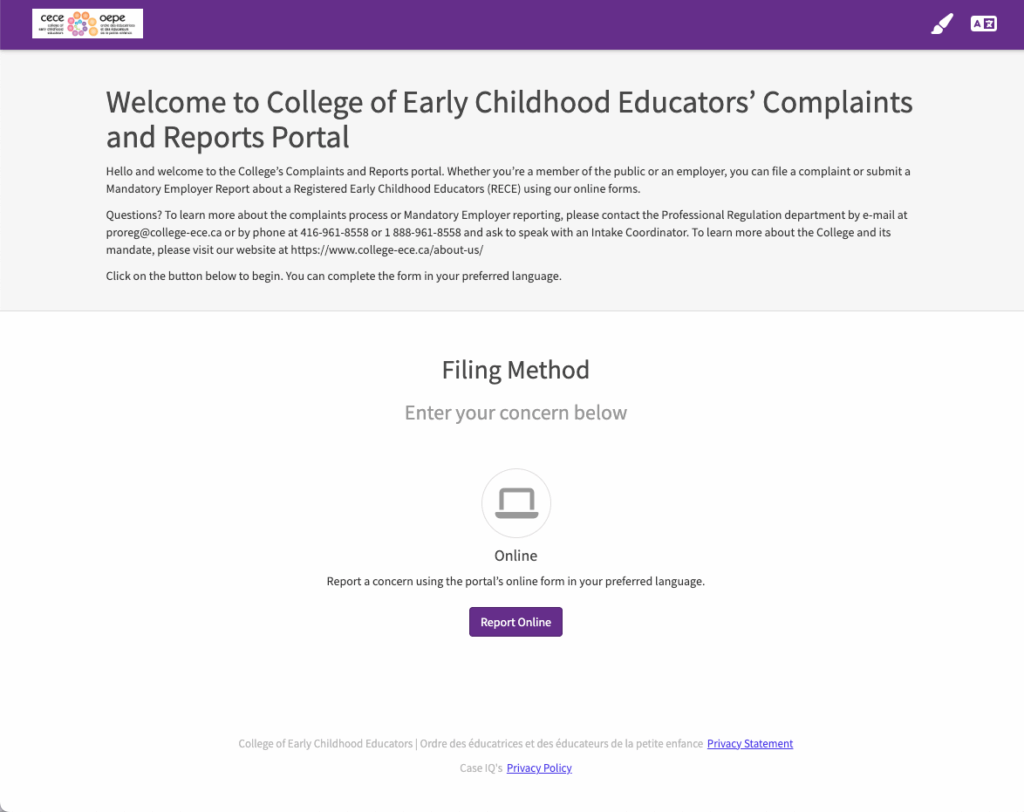
Employers can access the portal through https://college-ece.caseiq.app/portal. Click Report Online.
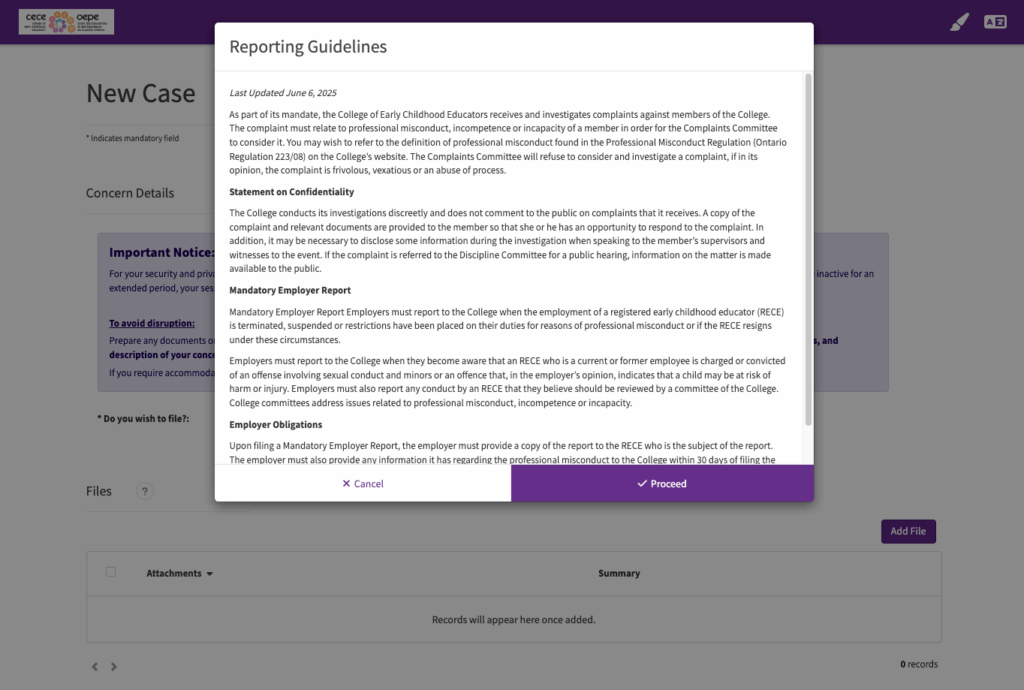
Read through the Reporting Guidelines to acknowledge that you have read and understood the Reporting Guidelines and click Proceed.
Do you wish to file? Choose Mandatory Employer Report.
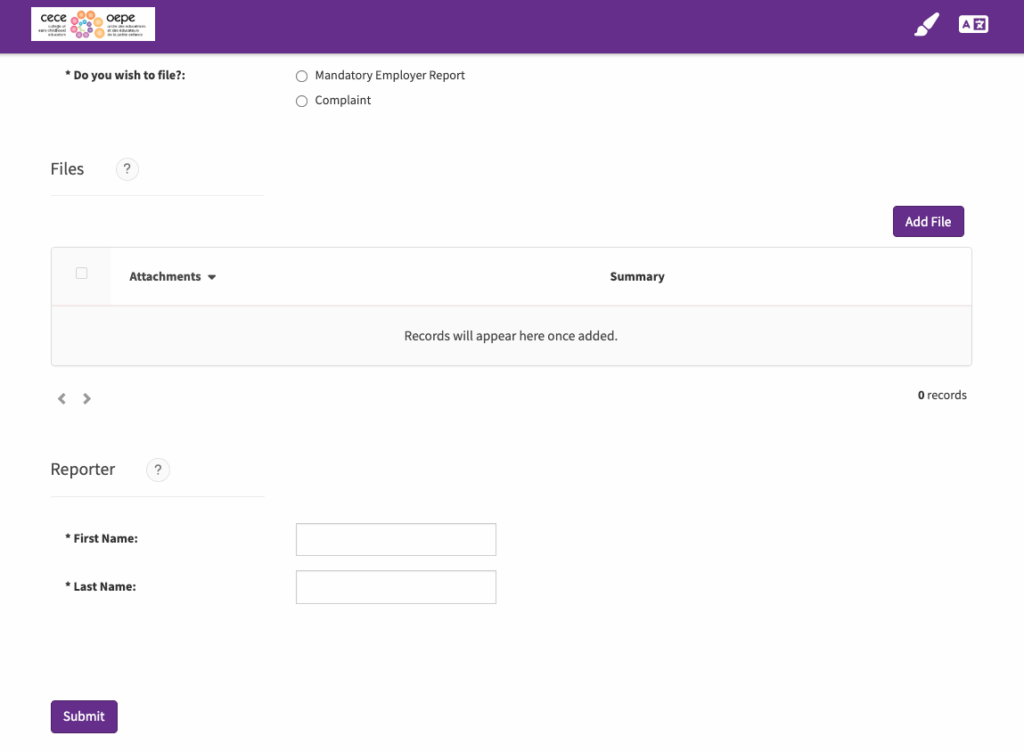
Once you choose Mandatory Employer Report, new fields will appear for you to complete, including information about the reporting employer, the member, your concerns, the employment outcome, previous concerns about the member, and additional contacts.
Add File. You may attach supporting documents, images, or videos to your case by adding a file (max 50 MB).
Once the information fields, supporting documentation and password authorization fields have been filled in. To ensure you receive a copy of your report and support the timely processing, the College requires your authorization to send any passwords to your confidential email. Confirm your submission and click Submit.
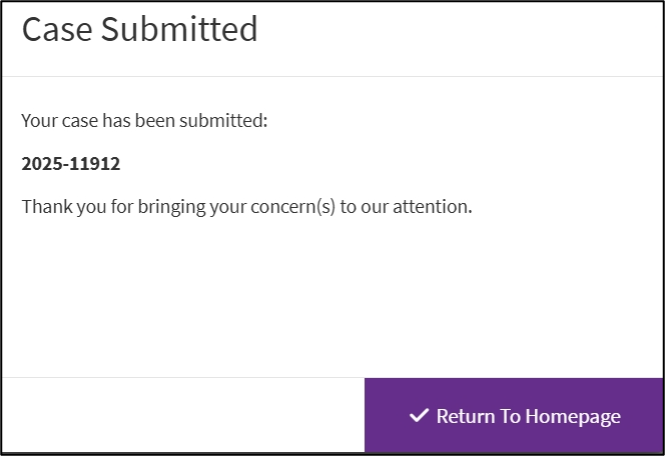
After submitting your file, a new window will pop up confirming Case Submitted. You may wish to save the file number for your records.
What happens once a MER has been filed with the College?
Once a MER has been submitted to the College, it goes through a rigorous intake process to assess the level of risk to the public and ensure the most efficient and expedient resolution, that will both ensure public protection and fairness to the RECE.
Learn more about what happens when MERs are submitted.
Please note: For those who require it, Mandatory Employer Reports will continue to be accepted in PDF format; for any questions, please contact the Professional Regulation department at proreg@college-ece.ca or by phone at 416-961-8558 or 1 888-961-8558 and ask to speak with an Intake Coordinator.
Now available: New Practice Note: Preventing Professional Dishonesty
Now available, the new Practice Note: Preventing Professional Dishonesty was developed to educate Registered Early Childhood Educators (RECEs) about professional dishonesty and its consequences, while also empowering them to practise with integrity. Additionally, it can support Early Childhood Education program students in understanding the importance of honesty in their academics, practicum experiences and professional interactions, as they prepare to enter the profession.
Supplying truthful information and maintaining accurate records demonstrates an RECE’s dedication to ethical and professional conduct as specified in the Code of Ethics and Standards of Practice. This includes the documentation of challenges or errors, such as a missed fire drill or a mistake in medication administration, to ensure transparency and accountability.
The Practice Note: Preventing Professional Dishonesty is designed to help RECEs:
- Recognize what constitutes professional dishonesty and its potential consequences;
- Understand how dishonesty in documentation, communication or reporting can affect children, families, colleagues and the public; and
- Embrace professional honesty as a foundation for ethical and accountable practice.
The resource explores some key areas where honesty is essential in RECE practice, including documentation and reporting, communication and declarations to the College.
Supplementary resources
RECEs can explore three companion resources with scenarios that focus on honesty in:
How you can use these resources:
- Review the Practice Note, scenarios and linked materials.
- Share them with your staff, including students in placement.
- Use them to support staff discussions, community of practice conversations or team meetings.
- Support related continuous professional learning.
- Incorporate insights into policy development or reviews.
- Promote ethical practice across your organization.
By reviewing and reflecting on this new practice resource, RECEs can build confidence in their professional decision-making, promote accountability and contribute to public trust in the profession.
For questions or more information, please contact the Professional Practice department at practice@college-ece.ca.
Council Chair Kristine Parsons on fostering workplace environments where all belong
In Canada, ensuring protections and recourse for discrimination around sexual orientation, gender identity and gender expression is a matter of fundamental human rights. In the profession, the ECE Act, the Code of Ethics and Standards of Practice, and How Does Learning Happen set out requirements for inclusive leadership by RECEs whose practice values equity, diversity, inclusion and social justice.
For Council Chair Kristine Parsons, creating a workplace environment where all staff feel a sense of welcome, safety and belonging has been an important focus at RisingOaks Early Learning Ontario. As Director of Operations at RisingOaks, Kristine and her team are demonstrating leadership in the Waterloo region for the integration of diversity, equity, inclusion and belonging into the fabric of their organization.
Diversity, Equity, Inclusion and Belonging (DEIB): From planning to action
After three years of consultation and work with an expert advisor, RisingOaks now has a DEIB Action Plan that identifies four priorities:
- Weave DEIB into the fabric of RisingOaks Early Learning.
- Enhance the sense of belonging so that the many identities (and their intersections) of each RisingOaks community member can be seen and valued.
- Strengthen, and develop clear communication channels, both internal and external, regarding RisingOaks’ DEIB activities and achievements throughout the RisingOaks community and within the early learning and child care sector.
- Enhance organizational learning related to DEIB.
The plan, which supports RisingOaks in making their commitment to DEIB visible in their workplace, is now being implemented with support and oversight from a newly formed DEIB Committee. The committee includes an educator from each location, two family representatives, senior leadership, a board liaison, an external consultant as an advisor and admin/communications support.
One tactic or activity to help weave DEIB into the fabric of RisingOaks is the creation of “DEIB in Action” spaces in their child care centres. While DEIB is present within and across the child care centre, these will be dedicated, physical spaces to “foster inclusivity, open communication and shared contributions among families, staff and educators,” says Kristine. It’s a place to share information, highlight key actions, share progress and celebrate successes. It’s also a place to invite parents to contribute and have their say on the action plan. “Some of our centres have had a space like this for several years now and others are working on making it more purposeful.”
RisingOaks recently held a professional learning day that brought together 175 employees, where the DEIB Committee co-chairs invited staff to contemplate and discuss what the spaces should look and feel like, and how the spaces could be made welcoming by reflecting a wide range of identities, cultures and lived experience of children, families and team members. The day also included a workshop on neurodiversity in the workplace, as a key learning opportunity for all. This session was well received by staff and connected into their work with children.
While RisingOaks had support from a consultant to develop their DEIB Action Plan, Kristine encourages organizations that may not have this option to reach out to another centre that is further along in their DEIB journey, to share and gain knowledge, insights and experiences.
Practising inclusion every day
Workplace policies in combination with intentional practices support Kristine and team in making DEIB a way of being. “We have a statement on workplace harassment and discrimination that we post within all our child care centres so parents can see and understand our position and policies,” she says. “We also have a Communications Toolkit for Pride Month with a Frequently Asked Questions sheet for our employees, to support them in engaging in conversations with families to explain RisingOaks’ policies.”
RisingOaks also makes sure that books and materials that represent a wide range of identities and experiences, including gender identity, family structure and other aspects of intersectionality are out on out on bookshelves all the time, not just in June. Parents receive communications from centre supervisors in the lead-up to Pride Month so they’re aware of how the centres will celebrate it, but are also reminded that respecting and affirming all identities is an all-the-time approach.
However, Kristine acknowledges the challenges in trying to promote allyship. “It hasn’t always been easy,” Kristine says. “We have had some negative feedback on social media, but we don’t take those negative comments down. We respond calmly using our communications tools, and we work really hard to create a place of belonging for everyone.”
Embracing pronouns, embracing identities
As an inclusive employer, Kristine and the RisingOaks team also commit to actively using the names and pronouns of a staff member’s choice – an important acknowledgement and affirmation of their identity. RisingOaks also reviewed its policies to neutralize gender-based pronouns “she/her” and “he/him” to “they/them”. They also have gender-neutral, accessible washrooms at their centres.
As the person who oversees RisingOaks’ benefit program, Kristine also supports employee access to benefits and facilitates communication with providers. When working with providers, she asks them to communicate with staff members using their chosen name and gender, in cases where these differ from the legal name and gender indicated on benefits-related forms.
Respect, kindness and belonging
“I think the leadership really sets the tone for the environment within the child care setting,” says Kristine, noting that respect and kindness are at the root of all relationships.
Kristine recalls a courageous conversation among staffers where there was a diversity of thought in trying to understand different communities and identities. The conversation concluded by finding common ground – the shared desire to treat each other with respect, and their shared goal of the protection and well-being of children and families. “At the end of the day, as human beings, we all just want to belong.”
Learn more about RisingOaks Early Learning Ontario.
Read more about fostering inclusion:
- Celebrating Pride Month with Cora Payne RECE
- Resources for RECEs to learn more about Pride and the 2SLGBTQIA+ community
- A conversation with Two-Spirit leader and social justice advocate Teddy Syrette: Fostering inclusion through education and allyship
Related College resources:
- Practice Guideline: Diversity and Culture
- Practice Guideline: Child Development (in particular, sections 2, 4 and 5)
- Practice Note: Beliefs and Bias

A conversation with Two-Spirit leader and social justice advocate Teddy Syrette: Fostering inclusion through education and allyship
Teddy Syrette, Ozhawa Anung Kwe/Yellow Star Woman (they/them), is a Two-Spirit and First Nation Anishnabe and mental health expert from Rankin Reserve of Batchewana. Teddy holds a diploma in Social Service Work – Indigenous Specialization from Sault College and is recognized as a fierce advocate for both the rights of Indigenous people and the 2SLGBTQIA+ community. An influential community figure and thought leader, Teddy has brought their knowledge and expertise to numerous audiences, including speaking to children at Sault-area schools, facilitating workshops for the Ontario Secondary School Teachers’ Federation, and as a panelist at an Indigenous Knowledge Gathering at Humber College.
Through storytelling and personal life experiences, Teddy explains the history and importance of the term Two-Spirit and offers knowledge and resources essential for fostering a more inclusive and respectful workplace culture for those who identify as 2SLGBTQIA+.
Embracing Two-Spiritedness: Teddy’s Journey
While Teddy says that over time, there has been an increase in discussion on gender diversity and sexual orientation from a First Nations or Indigenous lens, understanding and embracing Two-Spiritedness has at times been a challenging journey.
“I was bullied as a child for being too different from the other kids. I was effeminate enough to be called derogatory names by my peers and family members. Outside of the home, I was brown enough to be treated differently because of my skin colour,” says Teddy. “Constant and regular bullying reprograms the entire being of a person, especially at a young age. It manifested into a decline in mental and emotional health and an increase in social isolation.” Teddy says that this “impacted my physical health as a teenager, which put me on a continuous journey of care and wellness.”
“[I] got involved in theater when I was 15,” says Teddy. “[It] really helped me find myself through storytelling and writing, affirming who I was.”
“[Then,] when I was in my 20s, I was a narrator for an Indigenous theater show in Garden River, Ontario. I was asked if my character was male or female and I didn’t know the answer,” says Teddy. “The producer introduced me to this term called Two-Spirit. She explained that Two-Spirit was a more inclusive and holistic term and suggested that I look into it.”
Two-Spirit is a term created by Elder Myra Laramee in 1990. “[It] means having a balance between maleness and femaleness. In Anishinaabe teachings, everybody or everything is given a spirit, and within that spirit there’s a masculine and a feminine part,” says Teddy. “A deeper-rooted meaning of Two-Spirit is having a connection to ourselves, the community and with Creator. In previous histories and teachings on roles for Two-Spirited people, many were conductors of ceremonies, Knowledge Keepers, Elders or Medicine People.”
Asking for help
Emphasizing the significance of personal worth, as a mentor and advocate for many individuals, Teddy conveys to others their value and the necessity of assisting those in need. “When others come to me struggling or questioning aspects of their identity, I try to remind them of a simple teaching I received when I was in elementary school: the Creator doesn’t make junk. The Creator provides us with purpose, gives us gifts that make us unique, and that’s what makes us different from everyone else,” Teddy says. “The Creator also gives us helpers along the way, and we don’t know who those helpers are until we find them, or until we’ve asked them for their help.”
Helpers “can be parents, grandparents, family. I remind them that help can also come through chosen family. Social workers, teachers, nurses, the Chief and Councils and Elders. No matter how different they are, what their story looks like, they will be there to help and understand you. When you ask for help, you also might find that you need more guidance, and you can always ask someone else.”
Teddy reminds us that:
- for a 2SLGBTQIA+ person, having one ally or one person to affirm them is showing love.
- showing kindness on a regular basis is harm reduction and supports suicide prevention; and
- it’s important to be kind to oneself when doing this work. Be kind when you’re trying to unlearn things about gender or unlearn things that you believe about other people.
The importance of education
Teddy frequently engages in discussions with children and teens regarding gender identity and shares the lessons imparted, and the children’s reception of Teddy’s words.
“Because I identify as Two-Spirit and gender fluid, how I express my identity looks different each day,” says Teddy. “Some days I’ll wear ribbon skirts, makeup or jewelry. Other days a skirt or a sweater, no makeup and an earring. Those little things are good icebreakers to have, especially when working with youngsters and children. When I am speaking with children, I see their eyes looking at my skirt and I’ll ask, ‘how many folks are asking themselves why that guy is in a dress?’ and all these little hands go up. Then I go into telling them about my name and ask what they think Two-Spiritedness means.” Teddy says that “it is important to have that little teaching at the very beginning of discussions.”
In workplaces, Teddy recommends a few strategies to foster education and promote a more inclusive and respectful workplace environment for 2SLGBTQIA+ employees and colleagues:
- Actively explore and advocate for professional training opportunities, such as conferences or gatherings. These opportunities should apply to allies or those within the 2SLGBTQIA+ community.
- Participate in ceremonies, receive cultural care, or consult with Elders. This provision should equally extend to 2SLGBTQIA+ peers and staff by attending a conference or pride as a representative.
- Share resources and education from events with the workplace.
- Develop procedures and policies in the workplace and inform employees of their protective rights.
Teddy points out that sharing a poster in the workplace or having names and pronouns in an e-mail signature does not communicate that there is an awareness with everyone. Training for all is essential.
To support those who are inquiring or thinking about transitioning while working, Teddy says employers should “provide clear communication outlining all the supports available, including time off, and if relevant, benefits and what may be covered by insurance.”
Being an ally
When it comes to allyship, Teddy adds, “an ally relationship is not a title that you give yourself. It is a title that is given to you by the community that you’re advocating and providing allyship for. That allyship is not a title that you put on a button or poster at your 9-to-5 job.”
Teddy remarks that for allies, there is a choice to engage in the work on any given day; however, individuals who identify as queer, trans, Indigenous, or as people of color do not possess the privilege to disengage from their identities. Furthermore, Teddy emphasizes the necessity for allies to embrace discomfort, as true allyship involves taking risks on behalf of others, both in their presence and absence. It is during these moments that the authenticity of advocacy is truly challenged and demonstrated.
__________________
About Teddy Syrette
O-zha-wa A-nung Kwe/Yellow Star Woman (Teddy Syrette) is from Rankin Reserve of Bat-che-wana First Nation of the Anishnabek, and currently lives in Sault Ste. Marie, Ontario. Ozhawa is a public speaker, event organiser, community developer, artist and drag queen. In 2021, they were honoured with the title of Two-Spirit International Warrior. In 2023, Teddy was awarded the Indigenous Professional of the Year Award by the Sault Ste Marie Chamber of Commerce. Since 2022, they have curated, organised and hosted several drag shows under the stage name Bette U. Wanna of Batchewana. Teddy is the founder and sole proprietor of Two-Spirit Anishnabe Storytelling & Advocacy and a founding member of the Two-Spirit Organising Committee of Bawating.
Learn more about Teddy
- Teddy Syrette | 2-Spirit Anishnabe & Mental Health Expert
- Teddy_2Spirit on Linktree
- Teddy Syrette chosen to receive peace prize – Sault Ste. Marie News
- ozhawaanung.com
- 2SLGBTQQIA+ Sub-Working Group MMIWGSLGBTQQIA+ National Action Plan Final Report
Read more about fostering inclusion:
- Council Chair Kristine Parsons on fostering workplace environments where all belong
- Celebrating Pride Month with Cora Payne RECE
- Resources for RECEs to learn more about Pride and the 2SLGBTQIA+ community
Related College resources:
- Practice Guideline: Diversity and Culture
- Practice Guideline: Child Development (in particular, sections 2, 4 and 5)
- Practice Note: Beliefs and Bias

Preserving a Way of Life
In early childhood education, post-secondary programs that partner with Indigenous Institutes provide a way of obtaining an ECE diploma by weaving academics with the cultural richness of Indigenous knowledge, values, community and traditions.
One such institute is First Nations Technical Institute (FNTI) an Indigenous-owned and -governed post-secondary institute, which offers an ECE program in partnership with Canadore College.
Cecil E. Isaac Jr., who is from the Mshiikenh indoodem (Turtle Clan), is a Cultural Advisor (CA) at FNTI and has been integral in implementing Indigenous Learning Outcomes (ILOs) into FNTI’s framework of teaching.
Born in Chatham Ontario, raised on Bkejwanong Territory, Walpole Island, Ontario, Cecil comes from a lineage that embraced and shared rich cultural teachings and who were survivors of the Residential school era. Cecil has been instrumental in revitalizing ceremonies within his family and community. We spoke to Cecil to learn more about Indigenous values and his experiences sharing the wisdom and knowledge of his culture with ECE students at FNTI and with young children in the community.
(Note to readers: Acknowledging the multitude of unique histories, languages, cultural practices and spiritual beliefs that exist among Indigenous Peoples, the following is not intended to represent the ways of knowing and being of all Indigenous Peoples).
Indigenous Learning Outcomes (ILOs)
Created by the Negahneewin Council, Indigenous Learning Outcomes (ILOs) allow for Indigenous knowledge to be embedded into the program curricula of colleges and institutes, including FNTI and its ECE program. Across seven ILOs, they look at: how colonization affected, and continues to affect, Indigenous communities; the connection between land and identity in Indigenous societies; strategies for reconciling Indigenous and Canadian relations; racism against Indigenous people; and approaches for engaging Indigenous community partners.
“ILOs ensure Indigenous ways of being are communicated to the very impressionable – our little people, our newborns – and how important it is to understand those cultural things,” says Cecil. “ILOs were implemented to take a deeper look into the Indigenous culture – the sacred bundles, the teachings, ways of life.”
Education as medicine
Education is valued as a powerful tool for healing. Education rooted in Indigenous knowledge allows Indigenous Peoples to reclaim and connect to the wisdom of their ancestors, revitalize language, address historical trauma, promote an understanding of reconciliation and foster pride in Indigeneity.
“Education is healing. Education is love, which is one of our values, our Grandfather Teachings,” says Cecil. “If you look at education as love and as healing, they can also be translated to education as medicine, and therefore educators are medicine to those young people. Our little ones, our future. It is very important to allow our little spirits to become involved.”
An Indigenous approach to education takes a holistic view, developing the body, mind, heart and spirit of learners. Classes in FNTI’s two-year ECE program may begin, for example, with a Knowledge Keeper doing a smudge ceremony or drum ceremony. Each semester, cultural activities are completed by the learners, such as a rattle ceremony or unburdening ceremonies, all guided by cultural advisors like Cecil. ECE students learn the significance of each activity and how it is important for the children they will be caring for and supporting out in community.
Cecil cites the medicine wheel to illustrate this holistic approach. “[You can] focus on the mental and emotional aspect of the medicine wheel, or the physical. How does it look at our spirituality? My question is not about the religion, but it’s about the spirituality which is medicine. Mental, emotional, physical, spiritual,” he says.
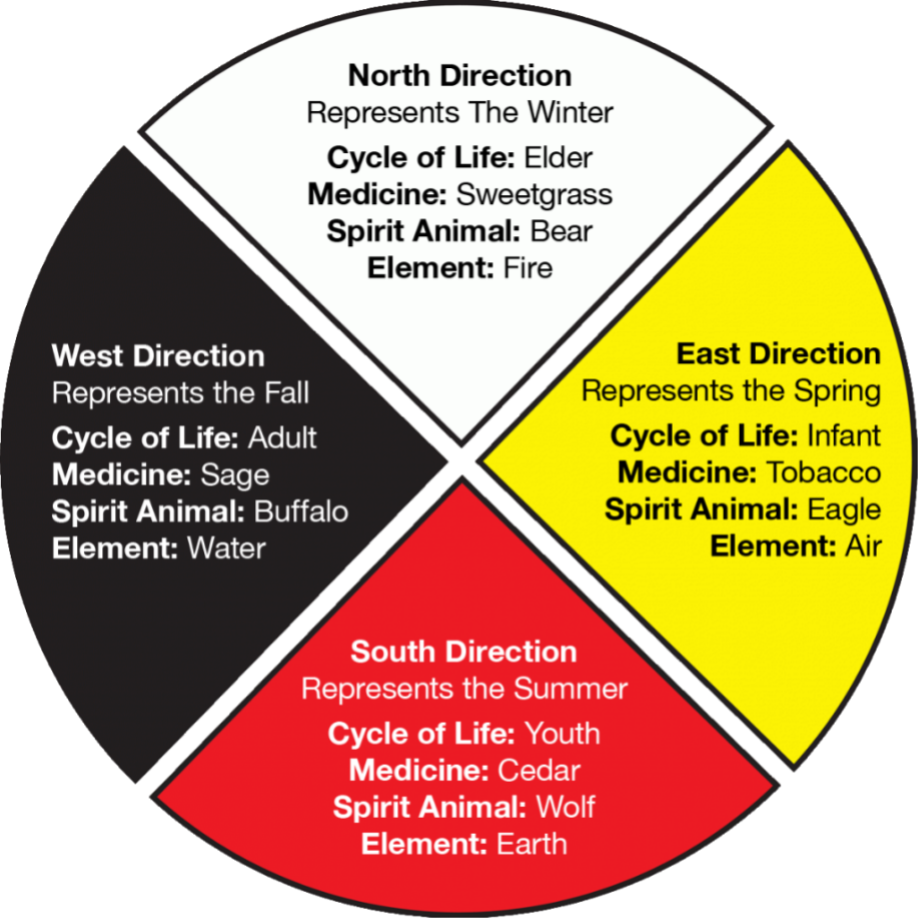
Photo Credit – Ojibway Medicine Wheel Teaching | Indigenous Domestic Violence Committee
Storytelling
First Nations, Inuit and Métis Peoples have a long and rich tradition of sharing stories and transferring knowledge through storytelling. Through storytelling, Elders and Knowledge Keepers help preserve the history, traditions and wisdom of their cultures; maintain spiritual connections; and reinforce connections to land and community. Stories are also at the heart of cultural experiences such as dance and ceremonies. In a learning setting, whether the setting is for ECE students or children in a child care setting, storytelling is a key tool for education and passing down Indigenous ways of knowing from one generation to the next.
Since students at FNTI come from all Indigenous cultures, FNTI’s teaching staff make space for storytelling by all. Cultural advisors and Instructors will share stories from their own cultural ways of knowing and being, and invite students to share their own stories and teachings as well.
Land-based Learning: ME (Mother Earth)
Land is sacred and deeply significant, representing a connection to one’s identity, community, and the past, present and future. Land-based learning encompasses much more than outdoor education. It emphasizes Indigenous worldviews and ways of knowing, acknowledging the interconnectedness of life and the importance of land in human existence. Land is central to Indigenous teachings.
“Our way, our Indigenous way, is very important – there is power in land. And land gives us the power to do a lot of things,” says Cecil. “To think about what comes from the Earth – everything comes from the Earth.”
As a Cultural Advisor and Elder, when Cecil asks children about “who they are,” there is a connection to land. He asks them to contemplate:
- Where do I come from? Not your address…
- Who am I? Not your name, but who are you?
- What is my purpose? There is a purpose for everything and everybody.
- Where am I going?
“It’s holding up something that we walked with. On our walk, we picked up a chunk of driftwood and brought it back and asked, what does this look like to you? That’s land-based education. Remember that oak tree we stood under? Then you draw the picture. And that’s for you. You don’t read into it, you just look at it and say, wow, what learning you have,” says Cecil. “When they can say who they are and tell me the whole story of where they came from, what they’re doing here and where they want to go while sitting in circle, we are also holding up something in our discussions and not reading from a book.”
Building Relationships: Family is community
Relationships are key in all Indigenous cultures. The concept of family goes well beyond Mom, Dad, Brother, Sister. It includes Elders, Grandmas and Grandpas, Aunties and Uncles, cousins and neighbours. Everyone plays a role in fostering the well-being and rearing of children. Relationships begin from birth and include relations with all that exists on Mother Earth that provides care and necessitates care – from land, nature and animals to family and community. Across Indigenous traditions, it is said that a child’s spirit chooses their parents even before entering the womb.
“The Grandmothers and Grandfathers, Aunties and Uncles who volunteer means more than volunteering services. It’s the connection we make with community,” says Cecil. “Maybe we can start to see those little individuals as human beings that are going to be adults someday. They’re going to be our future someday. We are responsible for them. As we say, it takes a whole community to raise a child. It takes a whole nation to raise a community.”
Learning more: How RECEs can expand their awareness and understanding of Indigenous knowledge and culture
Learning about Indigenous culture necessitates respect, transparency, a willingness to develop relationships and a commitment to gradually foster relationships. Each Indigenous community possesses a unique connection to their land, Elders, and ancestral wisdom, which shapes their identity.
Significant engagement often involves attentive listening, collaborating on initiatives, and ensuring that Indigenous perspectives are acknowledged and appreciated.
Erin Moe, Academic Dean, Partner Programs at FNTI, and Dr. Jennifer Davis, Assistant Professor, Queen’s University, shared the following recommendations for how RECEs may promote their understanding of Indigenous culture and build relationships:
- RECEs are urged to familiarize themselves with their local Indigenous communities and can also reach out to Indigenous families within their centres, and inquire if they might be willing to share their knowledge, understanding and teachings with staff and learners.
- Establishing connections with local communities requires time and effort. Engaging with Knowledge Keepers by connecting with local Indigenous organizations can facilitate access to training opportunities through workshops and programs.
- RECEs are encouraged to actively participate in the local events such as pow wows, or enrol in activities like beading and language classes, to begin fostering a relationship with nearby Indigenous Centres. It is important to note that many local Indigenous Centres are not exclusively available to Indigenous community members.
The journey begins with self-awareness and a genuine openness to listen and learn.
__________________
Acknowledgements
The College gratefully acknowledges the contributions of Cecil E. Isaac Jr., Cultural Advisor, Partner Programs, First Nations Technical Institute; Erin Moe, Academic Dean, Partner Programs, First Nations Technical Institute; Dr. Jennifer Davis, Assistant Professor, Queen’s University, and Elder Deb St. Amant, Elder-in-Residence, Queen’s University who generously shared their time, expertise and lived experiences with us so that we could further our learning in Indigenous ways of knowing and being.
Additional sources
- The Land is our Identity by Raechel Wastesicoot
- First Nations Pedagogy Online Project
- Reclaiming Education: Indigenous Control of Indigenous Education by Lateisha Ugwuegbula, Social Connectedness Fellow 2020, Samuel Centre for Social Connectedness in Partnership with the Misipawistik Cree Nation
- Ojibway Medicine Wheel Teaching
Perspectives on mental well-being through the lens of Black RECEs
One of the College’s key objectives is to contribute to the development of a resilient and sustainable profession. Supporting our members and their well-being is a critical component of that. As care-based professionals, RECEs have many important and demanding responsibilities and regularly put the needs of others ahead of their own. Fatigue and burnout are important concerns. In addition, RECEs from equity-deserving groups carry cultural and emotional burdens which may not be well-understood by, or top-of-mind for, others.
As part of our conversation series highlighting Black history and excellence, we continue the important dialogue with Tonja Armstrong-MacInnis, Deirdra Joseph and Nicole Cummings-Morgan, who are co-leads of the Community of Black ECEs, a Care Collective of the Association of Early Childhood Educators of Ontario (AECEO). Formed at the height of the pandemic when the world grappled with the murder of George Floyd, the Community of Black ECEs filled a need for Black RECEs across Ontario, providing a space where Black RECEs could come together to share their stories, experiences, ideas and resources.
In this discussion, we learn about the impact of fatigue and burnout on the well-being of Black RECEs.
In a profession challenged by educator fatigue and burnout, how and why is the mental toll different among Black RECEs?
Nicole: “Fatigue and burnout impact Black RECEs’ mental health differently because most RECEs who are not Black struggle with not feeling valued, being underpaid, and disappointed in a system that doesn’t see the importance of quality early childhood experiences. Black RECEs feel all of these things WHILE feeling overlooked for job promotions, and hearing micro-aggressive comments made by coworkers, families, and sometimes even children. I remember in one of our [Community of Black ECEs] meetings, an RECE shared that a child told her to wash her hands. She said she looked at her hands to see what the child was referring to and when she said to the child, ‘What do you mean? There’s nothing on my hands,’ the child said, yes, pointing to her skin, ‘Your hands are Black, they’re dirty.’ Imagine. Imagine hearing this from a four or five-year-old.
I also remember one member sharing that the parents in a kindergarten public school would not drop their child off unless the Caucasian teacher was there. Thankfully, the teacher was an ally who shut that down!
For me, I remember when I first started working in the kindergarten program. The area was predominantly European. The educator would treat the children in a way that went against all of what I had known from the Code of Ethics & Standards of Practice, How Does Learning Happen?, ELECT and more. I remember feeling so horrible that I couldn’t do more to advocate for them because I was the only Black educator in the space. And believe it or not, being the only Black educator made me feel powerless. I felt like I had no one to talk to. I felt like I was alone. When I did finally share how I felt, my manager started treating me poorly – that’s the short story. Let’s just say that until this day, if I were to see that individual, my body would respond to the trauma that was associated to that experience. As a person of faith, I was blessed and received the request that I asked for.
“So, when non-Black RECEs are complaining about the challenges in the profession, we can join in and appreciate this, and even feel a great connection as we suffer together in a profession that we all love. And yet, while we can definitely feel a sense of camaraderie in sharing the challenges and lack of recognition faced by all RECEs, it’s important to remember that Black and racialized RECEs bear an additional mental health toll tied to experiences of racism and microaggressions that their Caucasian peers do not. And, no, it’s not a competition, it is OUR reality!”
Deirdra: “I believe that for many Black RECEs, stereotypes, microaggressions and cultural misunderstanding add to the already challenging environment of early childhood education. At times, you cannot be your authentic self because it may not be accepted in the work environment and may be viewed negatively. For example, a non-Black person has the freedom to get angry and not concern themselves with being labeled ‘aggressive’, ‘rude’ or ‘unprofessional’. Everyone gets angry at work. But when you also have to concern yourself about being labelled, which is often the case in the Black community, it can be emotionally draining and affect your mental health over time.”
Tonja: “With the rise in hate crimes, in a world that has an increase in everyday living expenses and stress – life is difficult for many. There are everyday struggles that can make you feel like you are not valued or do not deserve to be heard. This can limit your experiences in the world and put an added burden on your life and those who you care for. In addition, when folks say things like, “History is in the past – it is time to move on,” they do not understand that the past impacts the present, and there is healing that needs to be done. Trauma-informed pedagogy is important to be aware of and practice in our programs for colleagues, children and families. If we treat others in a manner that is unkind or unfair, and then you, as a Black person need to explain to someone why that treatment is not okay, it is exhausting.
We need to continually learn – we are at a time when information is accessible like never before, so if folks do not take the time to be informed, it sends the message that your identity is not important. It is hard to fill another’s cup when yours is running on empty.”
It is crucial to continue encouraging and facilitating discussions, education and awareness for all members, in order to be strong allies to RECEs belonging to equity-deserving groups.
For employers and RECEs who are looking to deepen their understanding of Black history and anti-Black racism, there are support resources available, including a list of children’s books curated by Tonja, Nicole and Deirdra which RECEs can read to children in their care, to foster meaningful conversations about diversity, inclusion and belonging.
Resources to support well-being:
- Wellness Resources
- Caring for Self and Others
- Mental Health: A Call to Care for Yourself and Others
- Jean Clinton explains pivotal role of RECEs in supporting children’s mental health
- More from the Community of Black ECEs:
Biographies
Tonja Armstrong-MacInnis, a 2021 Prime Minister’s Award Recipient for Teaching Excellence in Early Childhood Education, has over 30 years of experience in varying capacities within the field of early learning and care – including facilitating numerous workshops that incorporate early learning pedagogy with an anti-oppression and anti-racist lens. In addition to her diploma in Early Childhood Education, she holds a BA and MA in Early Childhood Studies. She is the Director of the Humber Child Development Centre and Manager of the City of Toronto’s Every Child Belongs Unit at Humber that consists of Resource Consultants and a Registered Nurse Practitioner.
Nicole Cummings-Morgan is a mentor, advocate, community connector and collaborator. In addition to her RECE designation, she’s also an Ontario Certified Teacher, a professor in Early Childhood Education, an author and the owner and Executive Director of W1derus Educational Workshops Inc. W1derus Educational Workshops Inc. is a social enterprise dedicated to providing personal and professional workshops that contribute to the holistic well-being of individuals throughout their lifespan. Nicole is a former member of the Board of Directors of the Association of Early Childhood Educators of Ontario and the founder of the Community of Black ECEs.
Deirdra Joseph began her Early Childhood Educator journey at Seneca College. During her time as an RECE, she would often connect with the children who had needs, particularly those with Autism. This led her to obtain her Resource Teacher certificate and completing the Autism and Behavioral Science program at Seneca College. She also holds a bachelor’s degree in music. She currently works for the City of Toronto as a Resource Consultant.